Spec sheet · Fuji Electric
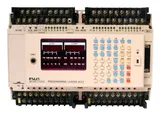
Fuji Programmable Controller FUJILOG-uTmini
Spec sheet5 pagesPDF 658 KB
Fuji Electric Review article on the FUJILOG-uTmini small programmable controller, with its system makeup, specifications and programming.
Covers · 1 model
The models it covers
Summary
What is in it
A five-page article from Fuji Electric Review (1983) introducing the FUJILOG-uTmini, a small general purpose programmable controller derived from the FUJILOG-uT. It describes the building block makeup (T40 and T40P basic units, expansion units, the A12T program loader, cassette and PROM writing tools), gives a specifications table (program capacity, cycle time, I/O points, power, environment, dimensions, weight), explains how the basic unit and I/O cards work, and covers programming. The text was read from a scan.
Its parts
- Introduction
- Composition
- Specifications and Functions
- Programming
- Post Script
From the sheet · read page by page
Key facts from this sheet
Some pages are scans or cannot be read; this says only what the readable text supports. Each line names its page in the PDF.
A five-page Fuji Electric Review article from 1983 describing the FUJILOG-uTmini (Fujilog MicroT Mini), a small programmable controller built as a lower grade model of the FUJILOG-uT. It explains the building-block system of T40 and T40P basic units, expansion units and program loader, and gives the specifications, I/O card ratings, alarm indicators and memory addressing. The text was read by OCR from a scan, so some table entries are garbled.
- Device
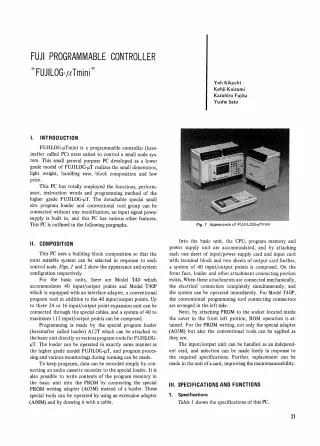
- Small general purpose programmable controller, a lower grade model of the FUJILOG-uT with the same instructions and programming method p. 1
- Basic units
- T40 with 40 I/O points; T40P adds an interface for conventional FUJILOG-uT program tools p. 1
- I/O expansion
- Up to three 24 or 16 point expansion units, for 40 to a maximum of 112 I/O points p. 1
- Program memory
- 1024 words of CMOS RAM backed up by a capacitor, with optional NiCd or lithium battery backup p. 2
- Cycle time
- About 20 msec for 1024 words p. 2
- Instructions
- R, A, O, W, MRG, NRG, TMR, CTR, SR, SC p. 2
- Power
- AC100/110V (-15 to +10%) 50/60Hz; maximum 100VA (basic system 70VA, 10VA per expansion unit) p. 2
- Environment
- 0 to 50°C operating, -10 to 70°C storage, 10 to 85%RH without condensation p. 2
- I/O cards
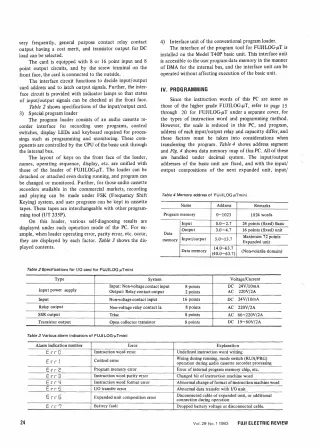
- 16 point DC 24V input card; 8 point relay output AC 220V/2A; 8 point triac SSR output AC 80~220V/2A; 8 point open collector transistor output DC 19~60V/2A p. 4
- Self-diagnosis
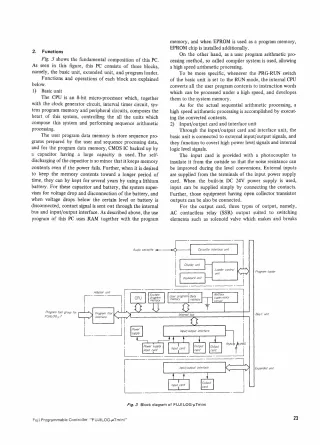
- Watch dog timer, parity error, battery failure, voltage drop and program check p. 2
- Status contacts
- STX contact on during normal operation; BAT contact on when the battery fails or voltage drops p. 2
- Program tools
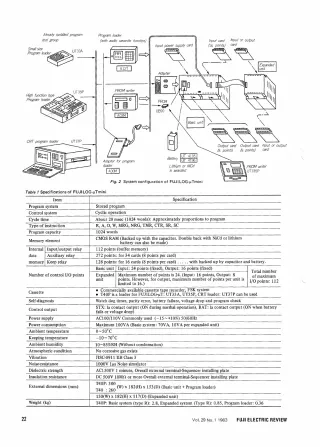
- A12T program loader with audio cassette function, A03M PROM writing adapter; on T40P, FUJILOG-uT loaders UT33A, UT35P and CRT loader UT37P p. 1, 2
- Dimensions
- T40: 260 (W) x 182 (H) x 153 (D) mm with loader; expansion unit 130 (W) x 182 (H) x 117 (D) mm p. 2
What this sheet walks you through
- How the basic unit, expansion units and program loader fit together p. 1, 2
- Saving programs to an audio cassette or a PROM p. 1
- Wiring inputs with the built-in DC 24V supply p. 3
- I/O addressing and the data memory map p. 4, 5
- Alarm indicators shown on the program loader p. 4
Good to know
- Programs moved from a FUJILOG-uT must allow for different I/O relay addresses and capacity. p. 4
- The installation atmosphere must be free of corrosive gas. p. 2
Questions this sheet answers
How many I/O points does the FUJILOG-uTmini support?
The T40 and T40P basic units have 40 I/O points, and up to three expansion units bring a system to a maximum of 112. p. 1
What power supply does the FUJILOG-uTmini use?
AC100/110V at 50/60Hz, drawing at most 100VA. p. 2
How do I back up a FUJILOG-uTmini program?
Record it to a commercial audio cassette recorder through the program loader, or write it to a PROM with the A03M adapter. p. 1
What does the battery fault alarm mean?
The battery voltage has dropped or its cable is disconnected. p. 4
The whole text · 1 part
Read the sheet here as text
Its text as extracted from the PDF, unedited, in parts; each page opens the PDF at that page.
The file