Spec sheet · Schneider
Control relays: K mini-control relays
Spec sheet8 pagesPDF 740 KB
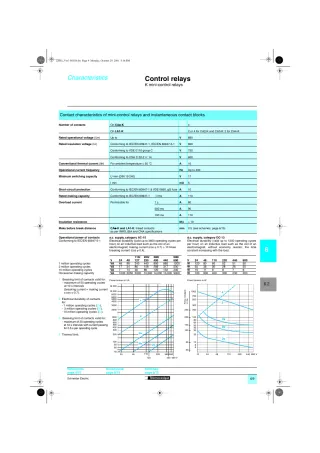
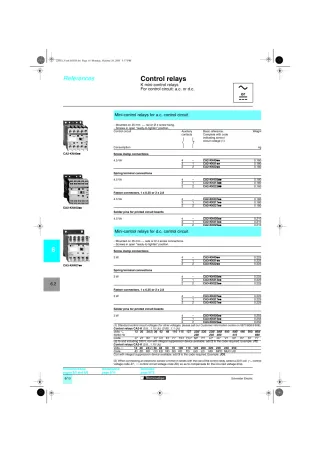
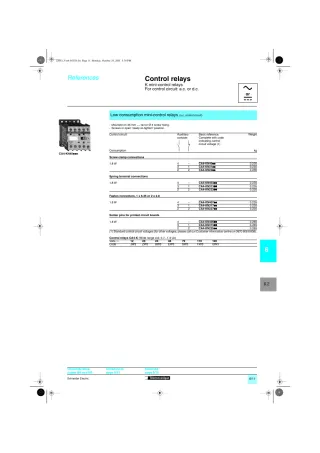
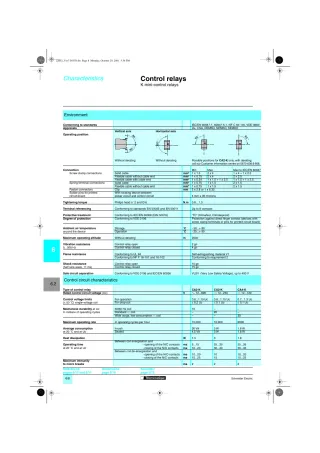
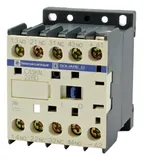
Catalog pages for Schneider Electric K mini-control relays (CA2-K, CA3-K, CA4-K), including the d.c. CA3-KN22 with 2 N/O + 2 N/C contacts.
Covers · 3 models
The models it covers
Summary
What is in it
Schneider Electric catalog pages for the K mini-control relays: CA2-K (a.c. control), CA3-K (d.c. control, the family of the CA3-KN22BD) and CA4-K (low consumption). They give environment and control circuit characteristics, contact ratings and electrical durability, part references with coil voltage codes, add-on instantaneous auxiliary contact blocks, electronic time delay blocks, suppressor modules and mounting accessories, dimensions and wiring schemes.
Its parts
- Characteristics
- References
- Dimensions
- Schemes
From the sheet · read page by page
Key facts from this sheet
Each line names its page in the PDF.
Schneider Electric catalog pages on the K mini-control relays CA2-K, CA3-K and CA4-K and their add-on contact blocks, suppressors and accessories. The site files it under the CA3-KN22BD; the pages list the CA3-KN22pp reference among the CA3-K relays, completed with a code for the control circuit voltage. They give characteristics, references, dimensions and wiring schemes for choosing and fitting these relays.
- Device type
- K mini-control relay; CA3-K types are for d.c. control circuits, mounted on 35 mm rail or Ø 4 screw fixing p. 3
- Control voltage
- CA3-K: 12...250 V d.c.; standard coils 12, 20, 24, 36, 48, 60, 72, 100, 110, 125, 200, 220, 230, 240, 250 V p. 1, 3
- Operating range
- CA3-K: 0.8...1.15 Uc p. 3
- Contacts
- 4 on the relay; up to 2 or 4 more with an LA1-K block on CA2-K and CA3-K p. 2
- Contact ratings
- Ue up to 690 V; Ith 10 A at 50 ˚C ambient or less; gG fuse 10 A p. 2
- Minimum switching
- 17 V, 5 mA p. 2
- Integral suppression
- CA3-K coil with integral suppression device: add 3 to the voltage code (example JD3) p. 3
- Contact blocks
- LA1-KN20, LA1-KN02, LA1-KN11 (screw clamp); 4-contact LA1-KN40, -KN31, -KN22, -KN13, -KN04 for CA2-K and CA3-K only p. 5
- Time delay blocks
- LA2-KT2E (a or c 24...48 V) and LA2-KT2U (a 110...240 V), on-delay 1...30 s p. 5
- Suppressor modules
- Clip-on with LED: LA4-KE1B, LA4-KE1E, LA4-KE1FC, LA4-KE1UG (a and c); LA4-KC1B, LA4-KC1E (c); LA4-KA1U (a 220...250 V) p. 6
- Mounting plates
- LA9-D973 (clip-on, 1 rail); DX1-AP25 (2 rails, 110/120 mm fixing centres) p. 6
- Marking
- LA9-D90 marker holder; AB1-Rp number and AB1-Gp letter clip-in markers, 4 maximum per relay p. 6
What this sheet walks you through
- Choosing a relay reference and control voltage code p. 3, 4
- Contact ratings for a.c. (AC-15) and d.c. (DC-13) loads p. 2
- Choosing instantaneous and time delay auxiliary contact blocks p. 5
- Choosing suppressor modules and mounting and marking accessories p. 6
- Mounting dimensions on panel, rail and printed circuit board p. 7
- Contact wiring schemes for relays and add-on blocks p. 8
Good to know
- With an electronic sensor or timer in series with the coil, a 20 V coil is chosen to make up for the voltage drop. p. 3
- The 4-contact LA1-K blocks fit only CA2-K and CA3-K relays. p. 5
- Suppressor modules add a slight delay on drop-out. p. 6
- Mounting positions other than those shown, with derating, are possible for CA2-K only. p. 1
Questions this sheet answers
What control voltages does the CA3-K relay come in?
Standard d.c. coils from 12 V to 250 V, including 24, 48, 110 and 220 V. The relay operates at 0.8 to 1.15 times its rated control voltage. p. 3
How many contacts can a CA3-K relay have?
It has 4 contacts, and an LA1-K block adds 2 or 4 more on CA2-K and CA3-K relays. p. 2
Is there a time delay add-on for K mini-control relays?
Yes, the LA2-KT2E (a or c 24 to 48 V) and LA2-KT2U (a 110 to 240 V) on-delay blocks, timing 1 to 30 s, clip on the front. p. 5
What is the contact current rating of the K mini-control relay?
Conventional thermal current is 10 A at an ambient of 50 ˚C or less, with up to 690 V rated operational voltage. p. 2
Contents
Chapters and sections
Each line opens the PDF at its page.
The whole text · 1 part
Read the sheet here as text
Its text as extracted from the PDF, unedited, in parts; each page opens the PDF at that page.
The file