Manual · Fanuc
Fanuc DL330 / D3-330, GE DL330 / D3-330, GE Fanuc DL330 / D3-330 and Siemens TI330 Manual
Manual3 pagesPDF 243 KB
All 3 pages are below, each with its text.
Names · 3 models
The models it names
 GE DL330 / D3-330CPU module from$268.002 in stock Fanuc DL330 / D3-330CPU module Call for availability GE Fanuc DL330 / D3-330CPU module Call for availability
Filed with · 1 model
Also filed with these models on the old site
From the manual · read page by page
Key facts from this manual
Each line names its page in the PDF.
Three catalog pages on the DL305 family CPUs D3-330, D3-340 and D3-350 (the D3-330 is also labeled DL330): key features, a CPU specification table and communications options. They show the status LEDs, memory and battery options, hardware switches, the D3-340 RS232C port settings, and how each CPU connects to programmers and DirectNET or MODBUS RTU networks.
- Type
- DL305 family CPU with on-board RAM and a battery p. 1, 2
- D3-330 switches
- D3-330: 2-position dipswitch for retentive memory; jumpers for UVPROM or RAM p. 1
- UVPROM option
- D3-CPU-UV, four chips per pack (one needed); needs a D3-PWU Prom Writer Unit p. 1
- D3-330 communications
- D3-330: a DL305 Data Communications Unit is needed for any device other than a handheld programmer p. 3
- D3-330 programming
- D3-330: DirectSOFT programming needs a Data Communications Unit (DCU) p. 2
- Spare battery
- D3-D4-BAT, lithium 3.0V (also for D4-430 and D4-440 CPUs) p. 1
- Status LEDs
- RUN, BATT, CPU and PWR; D3-340 adds Port1 and Port2 RX/TX p. 1
- D3-340 EEPROM
- D3-340: optional D3-340-EE EEPROM, four chips per pack; no extra programming device p. 1
- D3-340 ports
- D3-340: two built-in RS232C ports, DirectNET, RJ11, addresses 01 to 90 p. 3
- D3-340 baud rates
- D3-340: 300 to 38400 baud; parity none or odd; 8 data bits, 1 start, 1 stop p. 3
- D3-340 switches
- D3-340: memory jumper, two rotary address switches, eight-position dipswitch for baud, mode and memory p. 1
- Network master
- D3-340 and D3-350: bottom port is a DirectNET master for up to 90 slaves p. 3
- D3-350 MODBUS
- D3-350: MODBUS RTU master for up to 247 slave stations p. 3
What this manual walks you through
- Reading the CPU status LEDs p. 1
- Choosing EEPROM or UVPROM memory p. 1
- Setting the CPU hardware switches p. 1
- Comparing DL305 CPU specifications p. 2
- Choosing a CPU for communications p. 3
- Using a DL305 CPU as a network master or slave p. 3
- Writing custom drivers with ASCII/BASIC modules p. 3
Good to know
- The Data Communications Unit has only one port. p. 3
- There are restrictions on which DL205 and DL405 memory types a D3-340 master can read and write. p. 3
- The ASCII/BASIC modules are not supported by the D3-350. p. 3
Questions this manual answers
Can I program a D3-330 with DirectSOFT?
Only with a Data Communications Unit (DCU) added to the system. p. 2
What battery does a DL305 CPU use?
The spare battery is the D3-D4-BAT, a lithium 3.0V cell also used in D4-430 and D4-440 CPUs. p. 1
What is the difference between the D3-330 and D3-340?
The D3-340 has two built-in RS232C ports; the D3-330 needs a Data Communications Unit to connect anything other than a handheld programmer. p. 3
What does the BATT LED on a DL305 CPU mean?
On means the memory backup voltage is low; off means it is good. p. 1
How many slaves can a D3-340 address as a DirectNET master?
Up to 90 slave stations, from its bottom built-in port. p. 3
The file
Size and text
Every page · 3
Read it here
Each page as it is printed, and its words beside it, so a phone can search and copy them.
Page1of 3
Open in the PDF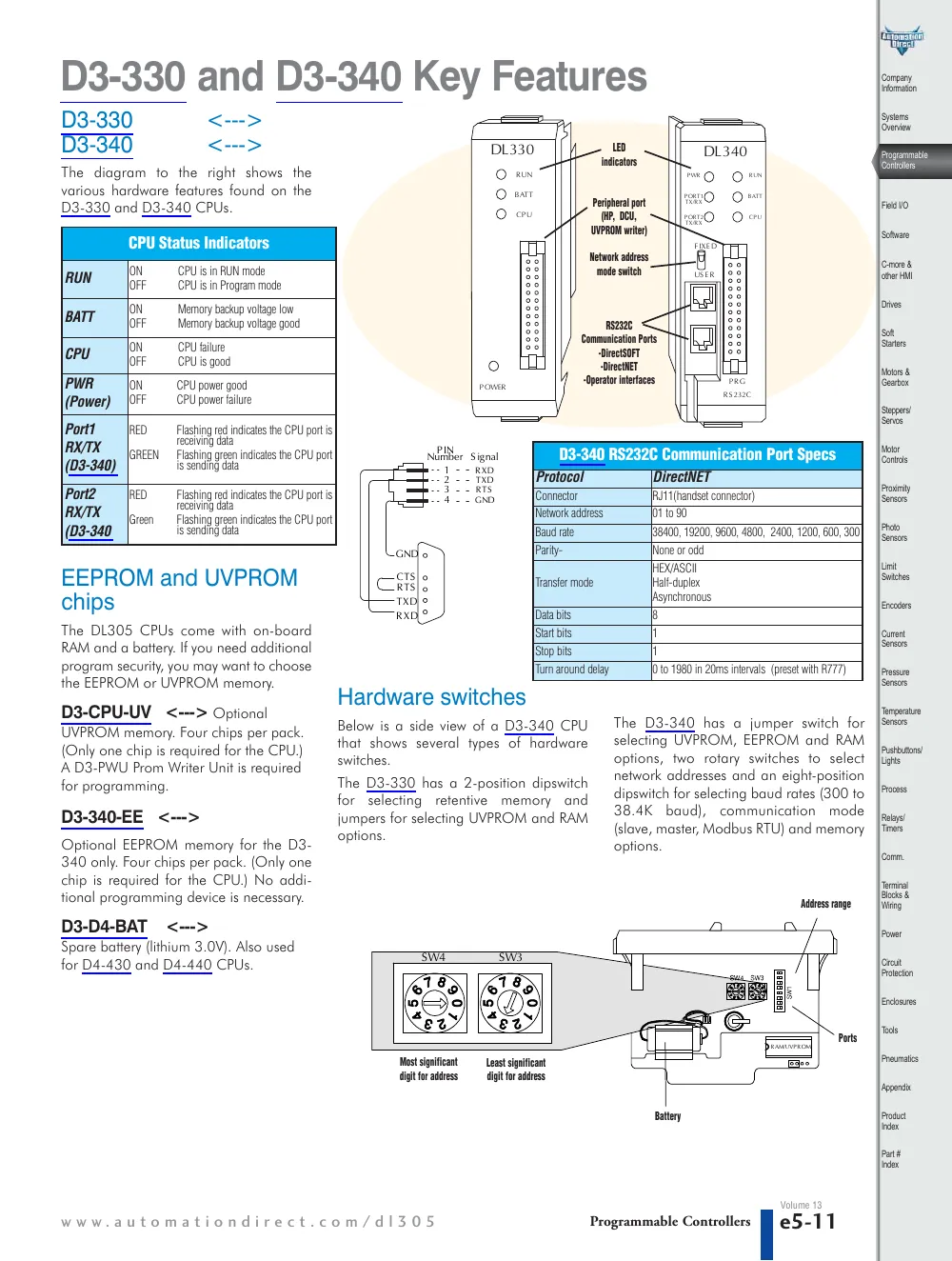
The text of page 1, from the PDF itself
D3-330 and D3-340 Key Features D3-330 D3-340
<---> <--->
Company Information Systems Overview
DL330
The diagram to the right shows the various hardware features found on the D3-330 and D3-340 CPUs.
LED indicatorsDL340R UN BATT
Peripheral port (HP, DCU, UVPROM writer)
CP U
ON OFF
CPU is in RUN mode CPU is in Program mode
BATT
ON OFF
Memory backup voltage low Memory backup voltage good
CPU
ON OFF
CPU failure CPU is good
PWR (Power)
ON OFF
CPU power good CPU power failure
Port1 RED RX/TX GREEN (D3-340)
Flashing red indicates the CPU port is receiving data Flashing green indicates the CPU port is sending data
Port2 RX/TX (D3-340
Flashing red indicates the CPU port is receiving data Flashing green indicates the CPU port is sending data
RED Green
The DL305 CPUs come with on-board RAM and a battery. If you need additional program security, you may want to choose the EEPROM or UVPROM memory.
D3-CPU-UV <---> Optional UVPROM memory. Four chips per pack. (Only one chip is required for the CPU.) A D3-PWU Prom Writer Unit is required for programming.
D3-340-EE <---> Optional EEPROM memory for the D3340 only. Four chips per pack. (Only one chip is required for the CPU.) No additional programming device is necessary.
P ORT1 TX/R XBATTP ORT2 TX/R XCP UField I/OF IXE D
Network address mode switch
C-more & other HMIUS E RDrives
RS232C Communication Ports -DirectSOFT -DirectNET -Operator interfaces
P OWER
Soft Starters Motors & Gearbox
PRG R S 232C
Steppers/ Servos
P IN Number S ignal 1 R XD 2 TXD RTS 3 GND 4
Motor Controls
D3-340 RS232C Communication Port Specs
GND
EEPROM and UVPROM chips
R UN
Software
CPU Status Indicators RUN
Programmable Controllers
P WRCTS RTS TXD R XDProtocolDirectNET
Connector Network address
RJ11(handset connector) 01 to 90
Baud rate
38400, 19200, 9600, 4800, 2400, 1200, 600, 300
Parity-None or oddTransfer mode
HEX/ASCII Half-duplex Asynchronous
Data bits Start bits Stop bits
8 1 1
Turn around delay
0 to 1980 in 20ms intervals (preset with R777)
Proximity Sensors
Limit Switches Encoders Current Sensors
Hardware switches Below is a side view of a D3-340 CPU that shows several types of hardware switches. The D3-330 has a 2-position dipswitch for selecting retentive memory and jumpers for selecting UVPROM and RAM options.
The D3-340 has a jumper switch for selecting UVPROM, EEPROM and RAM options, two rotary switches to select network addresses and an eight-position dipswitch for selecting baud rates (300 to 38.4K baud), communication mode (slave, master, Modbus RTU) and memory options.
Address range
D3-D4-BAT <---> Spare battery (lithium 3.0V). Also used for D4-430 and D4-440 CPUs.
Photo Sensors
Pressure Sensors Temperature Sensors Pushbuttons/ Lights Process Relays/ Timers Comm. Terminal Blocks & Wiring Power
SW4
SW3
Circuit Protection Enclosures
PortsToolsR AM/UVP R OM
Most significant digit for address
Pneumatics
Least significant digit for address
Appendix Product IndexBatteryPart # IndexVolume 13
w w w. a u to m at i o n d i re c t . c o m / d l 305
Programmable Controllers
e5-11
Page2of 3
Open in the PDF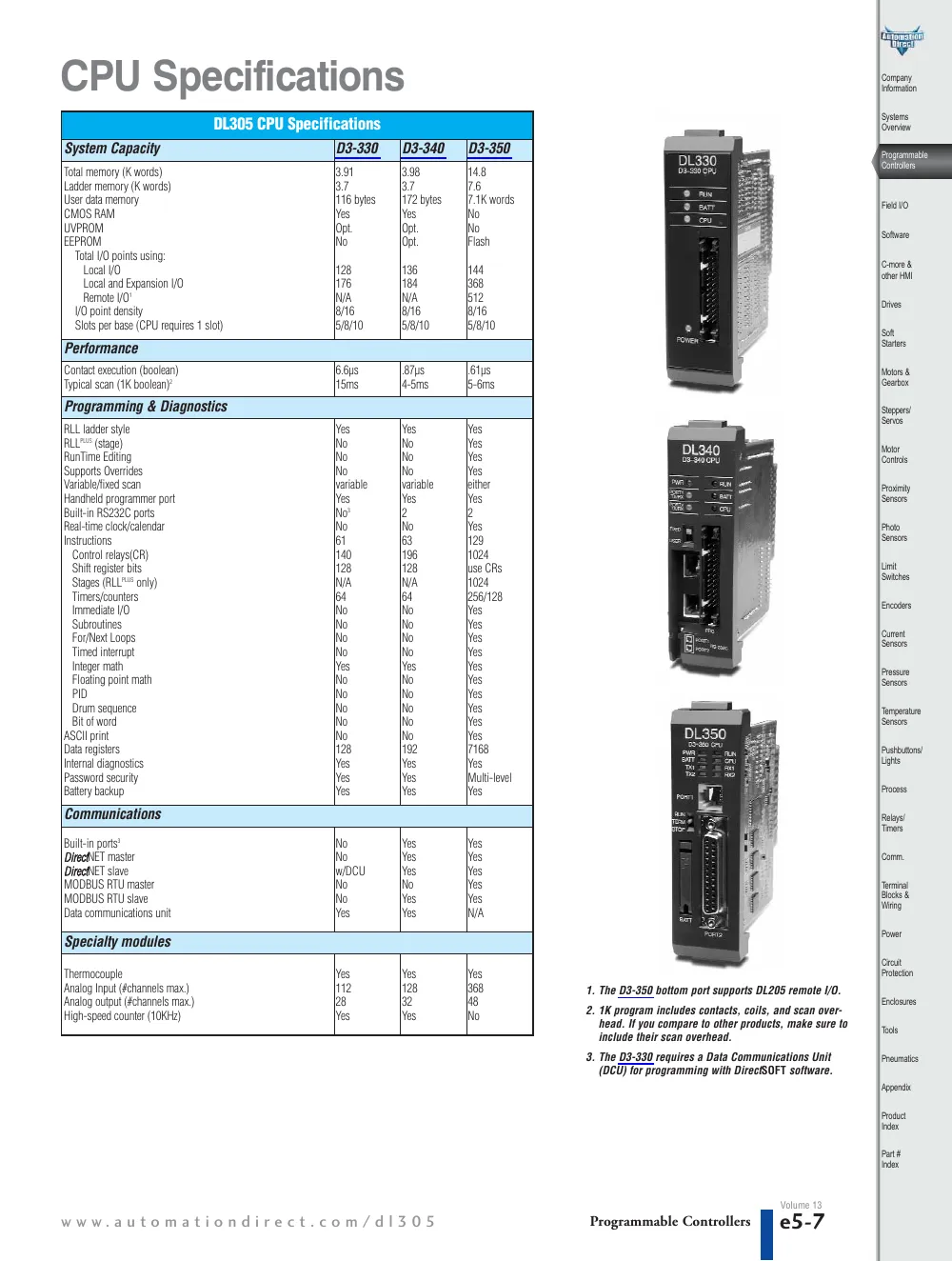
The text of page 2, from the PDF itself
CPU Specifications
Company Information Systems Overview
DL305 CPU Specifications System Capacity
D3-330D3-340D3-350
Total memory (K words) Ladder memory (K words) User data memory CMOS RAM UVPROM EEPROM Total I/O points using: Local I/O Local and Expansion I/O Remote I/O1 I/O point density Slots per base (CPU requires 1 slot)
3.91 3.7 116 bytes Yes Opt. No
3.98 3.7 172 bytes Yes Opt. Opt.
14.8 7.6 7.1K words No No Flash
128 176 N/A 8/16 5/8/10
136 184 N/A 8/16 5/8/10
144 368 512 8/16 5/8/10
C-more & other HMI6.6µs 15ms.87µs 4-5ms.61µs 5-6msMotors & Gearbox
Yes No No No variable Yes No3 No 61 140 128 N/A 64 No No No No Yes No No No No No 128 Yes Yes Yes
Yes No No No variable Yes 2 No 63 196 128 N/A 64 No No No No Yes No No No No No 192 Yes Yes Yes
Yes Yes Yes Yes either Yes 2 Yes 129 1024 use CRs 1024 256/128 Yes Yes Yes Yes Yes Yes Yes Yes Yes Yes 7168 Yes Multi-level Yes
Programmable Controllers
Field I/O Software
Drives Soft Starters
Performance Contact execution (boolean) Typical scan (1K boolean)2
Programming & Diagnostics RLL ladder style RLLPLUS (stage) RunTime Editing Supports Overrides Variable/fixed scan Handheld programmer port Built-in RS232C ports Real-time clock/calendar Instructions Control relays(CR) Shift register bits Stages (RLLPLUS only) Timers/counters Immediate I/O Subroutines For/Next Loops Timed interrupt Integer math Floating point math PID Drum sequence Bit of word ASCII print Data registers Internal diagnostics Password security Battery backup
Steppers/ Servos Motor Controls Proximity Sensors Photo Sensors Limit Switches Encoders Current Sensors Pressure Sensors Temperature Sensors Pushbuttons/ Lights Process
Communications Built-in ports DirectNET master DirectNET slave MODBUS RTU master MODBUS RTU slave Data communications unit 3
Relays/ TimersNo No w/DCU No No YesYes Yes Yes No Yes Yes
Yes Yes Yes Yes Yes N/A
Comm. Terminal Blocks & Wiring Power
Specialty modules Thermocouple Analog Input (#channels max.) Analog output (#channels max.) High-speed counter (10KHz)
Yes 112 28 YesYes 128 32 YesYes 368 48 NoCircuit Protection
1. The D3-350 bottom port supports DL205 remote I/O. 2. 1K program includes contacts, coils, and scan overhead. If you compare to other products, make sure to include their scan overhead. 3. The D3-330 requires a Data Communications Unit (DCU) for programming with DirectSOFT software.
Enclosures Tools Pneumatics Appendix Product Index Part # Index
Volume 13
w w w. a u to m at i o n d i re c t . c o m / d l 305
Programmable Controllers
e5-7
Page3of 3
Open in the PDF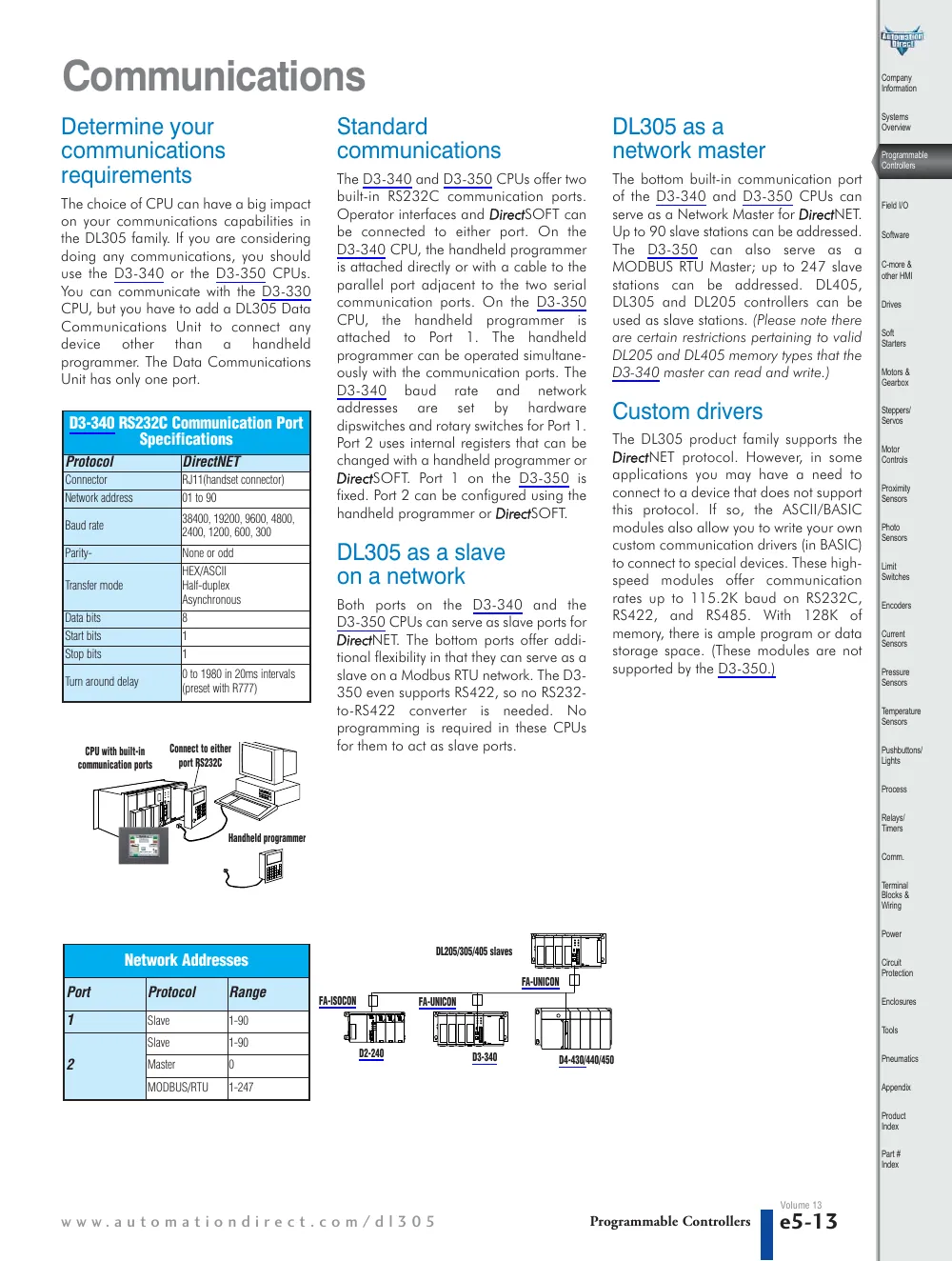
The text of page 3, from the PDF itself
Communications Determine your communications requirements The choice of CPU can have a big impact on your communications capabilities in the DL305 family. If you are considering doing any communications, you should use the D3-340 or the D3-350 CPUs. You can communicate with the D3-330 CPU, but you have to add a DL305 Data Communications Unit to connect any device other than a handheld programmer. The Data Communications Unit has only one port.
D3-340 RS232C Communication Port Specifications Protocol
DirectNET
Connector Network address
RJ11(handset connector) 01 to 90
Baud rate
38400, 19200, 9600, 4800, 2400, 1200, 600, 300
Parity-None or oddTransfer mode
HEX/ASCII Half-duplex Asynchronous
Data bits Start bits Stop bits
8 1 1
Turn around delay
0 to 1980 in 20ms intervals (preset with R777)
CPU with built-in communication ports
Connect to either port RS232C
Company Information Systems Overview
Standard communications
DL305 as a network master
The D3-340 and D3-350 CPUs offer two built-in RS232C communication ports. Operator interfaces and DirectSOFT can be connected to either port. On the D3-340 CPU, the handheld programmer is attached directly or with a cable to the parallel port adjacent to the two serial communication ports. On the D3-350 CPU, the handheld programmer is attached to Port 1. The handheld programmer can be operated simultaneously with the communication ports. The D3-340 baud rate and network addresses are set by hardware dipswitches and rotary switches for Port 1. Port 2 uses internal registers that can be changed with a handheld programmer or DirectSOFT. Port 1 on the D3-350 is fixed. Port 2 can be configured using the handheld programmer or DirectSOFT.
The bottom built-in communication port of the D3-340 and D3-350 CPUs can serve as a Network Master for DirectNET. Up to 90 slave stations can be addressed. The D3-350 can also serve as a MODBUS RTU Master; up to 247 slave stations can be addressed. DL405, DL305 and DL205 controllers can be used as slave stations. (Please note there are certain restrictions pertaining to valid DL205 and DL405 memory types that the D3-340 master can read and write.)
DL305 as a slave on a network Both ports on the D3-340 and the D3-350 CPUs can serve as slave ports for DirectNET. The bottom ports offer additional flexibility in that they can serve as a slave on a Modbus RTU network. The D3350 even supports RS422, so no RS232to-RS422 converter is needed. No programming is required in these CPUs for them to act as slave ports.
Programmable Controllers
Custom drivers
Field I/O Software C-more & other HMI Drives Soft Starters Motors & Gearbox Steppers/ Servos
The DL305 product family supports the DirectNET protocol. However, in some applications you may have a need to connect to a device that does not support this protocol. If so, the ASCII/BASIC modules also allow you to write your own custom communication drivers (in BASIC) to connect to special devices. These highspeed modules offer communication rates up to 115.2K baud on RS232C, RS422, and RS485. With 128K of memory, there is ample program or data storage space. (These modules are not supported by the D3-350.)
Motor Controls Proximity Sensors Photo Sensors Limit Switches Encoders Current Sensors Pressure Sensors Temperature Sensors Pushbuttons/ Lights Process Relays/ Timers
Handheld programmer Comm. Terminal Blocks & Wiring Power
DL205/305/405 slavesNetwork Addresses PortProtocolRange1Slave1-90Slave1-90Master0MODBUS/RTU1-2472Circuit ProtectionFA-UNICON FA-ISOCONFA-UNICONEnclosures ToolsD2-240D3-340PneumaticsD4-430/440/450
Appendix Product Index Part # Index
Volume 13
w w w. a u to m at i o n d i re c t . c o m / d l 305
Programmable Controllers
e5-13