Spec sheet · Schneider
LC1D25M7 Product data sheet
Spec sheet6 pagesPDF 149 KB
Product data sheet for the Schneider Electric TeSys D LC1D25M7 contactor: 3-pole, 25 A AC-3, 220 V AC coil.
Covers · 1 model
The models it covers
Summary
What is in it
The Schneider Electric product data sheet for the TeSys D contactor LC1D25M7, a 3-pole (3 NO) contactor for motor control and resistive loads with a 220 V AC coil. It lists ratings (operational voltage and current, motor power in kW and hp), making and breaking capacity, fuse coordination, terminal connections and torque, coil data, auxiliary contacts, environmental limits, dimensions and weight, certifications, and closes with dimension drawings and a wiring diagram.
Its parts
- Characteristics
- Dimensions Drawings
- Connections and Schema
From the sheet · read page by page
Key facts from this sheet
Some pages are scans or cannot be read; this says only what the readable text supports. Each line names its page in the PDF.
Schneider Electric product data sheet, dated Nov 27, 2018, for the LC1D25M7 TeSys D contactor: 3 poles, 25 A in AC-3, with a 220 V AC coil. The site files it under the LC1D25. It lists power and control circuit ratings, motor powers, terminals, environment and dimensions with add-on blocks.
- Device type
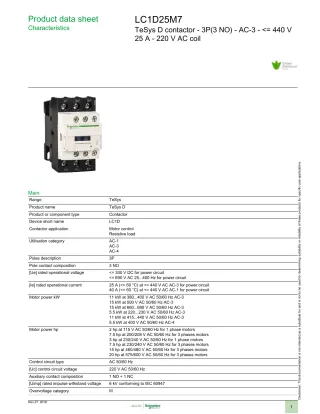
- TeSys D 3-pole contactor (3 NO) for motor control and resistive loads; AC-1, AC-3, AC-4 p. 1
- Rated current
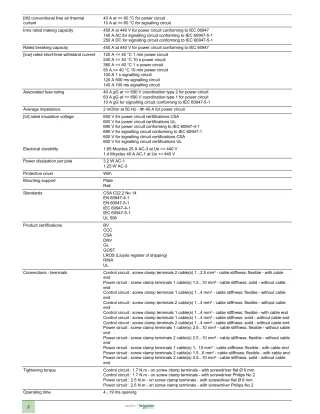
- 25 A AC-3 and 40 A AC-1 at <= 440 V AC (<= 60 °C) p. 1
- Rated voltage
- Power circuit <= 690 V AC 25...400 Hz or <= 300 V DC p. 1
- Motor power kW
- 5.5 kW at 220...230 V AC; 11 kW at 380...400 V AC; 15 kW at 500 V AC (AC-3) p. 1
- Motor power hp
- 3-phase: 7.5 hp at 230/240 V, 15 hp at 460/480 V, 20 hp at 575/600 V; 1-phase: 2 hp at 115 V, 3 hp at 230/240 V p. 1
- Auxiliary contacts
- 1 NO + 1 NC, mechanically linked; mirror contact (1 NC) p. 1, 3
- Coil
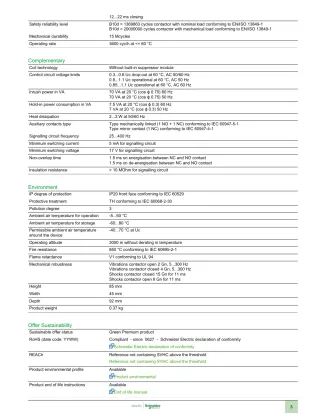
- LC1D25M7: 220 V AC 50/60 Hz, without built-in suppressor module p. 1, 3
- Coil consumption
- LC1D25M7: inrush 70 VA; hold-in 7 VA at 50 Hz, 7.5 VA at 60 Hz p. 3
- Fuse rating
- 40 A gG (type 2 coordination) or 63 A gG (type 1) at <= 690 V, power circuit p. 2
- Durability
- Mechanical 15 Mcycles; electrical 1.65 Mcycles at 25 A AC-3, 1.4 Mcycles at 40 A AC-1 p. 2, 3
- Size and weight
- 85 mm high, 45 mm wide, 92 mm deep; 0.37 kg p. 3
- Temperature
- Operation -5...60 °C; storage -60...80 °C p. 3
- Terminals
- Screw clamp; tightening torque 2.5 N.m power circuit, 1.7 N.m control circuit p. 2
- Mounting
- Plate or rail; IP20 front face p. 2, 3
What this sheet walks you through
- Choosing the contactor by motor power and voltage p. 1
- Wire sizes and tightening torque for the terminals p. 2
- Short-time withstand current and fuse coordination p. 2
- Coil voltage limits and consumption p. 3
- Overall dimensions with add-on blocks fitted p. 5
Good to know
- The coil has no built-in suppressor module. p. 3
- Operating rate is 3600 cycles per hour at 60 °C or less. p. 3
- The sheet is not meant for judging whether the product suits a specific application. p. 1
Questions this sheet answers
What size motor can an LC1D25 contactor switch?
In AC-3 it is rated 11 kW at 380 to 400 V AC, or 7.5 hp at 230/240 V and 15 hp at 460/480 V on 3-phase motors. p. 1
What coil voltage does the LC1D25M7 have?
220 V AC at 50/60 Hz. p. 1
What fuse protects an LC1D25 contactor?
40 A gG for type 2 coordination or 63 A gG for type 1, at up to 690 V. p. 2
How big is the LC1D25M7?
85 mm high, 45 mm wide and 92 mm deep, weighing 0.37 kg. p. 3
The whole text · 1 part
Read the sheet here as text
Its text as extracted from the PDF, unedited, in parts; each page opens the PDF at that page.
The file