Spec sheet · United Electric Controls
400 Series Pressure, Vacuum, Differential Pressure and Temperature Switches
Spec sheet16 pagesPDF 675 KB
Product bulletin for United Electric Controls 400 Series pressure, vacuum, differential pressure and temperature switches.
Covers · 1 model
The models it covers
Summary
What is in it
United Electric Controls bulletin for the 400 Series switches: vacuum, pressure, differential pressure and temperature switches with one, two or three SPDT outputs, set by reference dial (H types) or hex screw (J types). It gives the features, general specifications, agency approvals, model charts with set point ranges, deadbands and pressure limits for each model (including model 126 with a brass bellows sensor), temperature models, options, dimensions and how to order.
From the sheet
Key facts from this sheet
Each line names its page in the PDF.
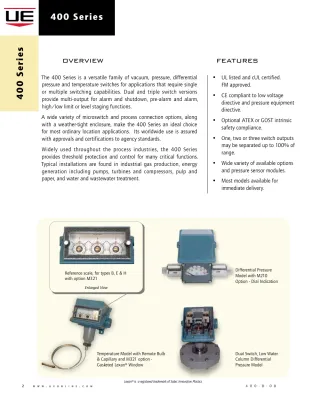
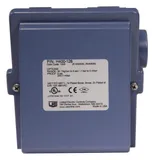
The United Electric Controls 400 Series catalog for pressure, vacuum, differential pressure and temperature switches with one, two or three switch outputs. The site files it under H400-126: type H400 (one SPDT output, adjusted with a reference dial) with model 126, a brass bellows pressure sensor. It gives specifications, approvals, model charts, ordering options and dimensions.
- Type H400
- Pressure switch, one SPDT output, internal adjustment with reference dial p. 11
- Model 126 sensor
- Brass bellows with nickel-plated brass 1/4" NPT (female) pressure connection p. 7
- Electrical rating
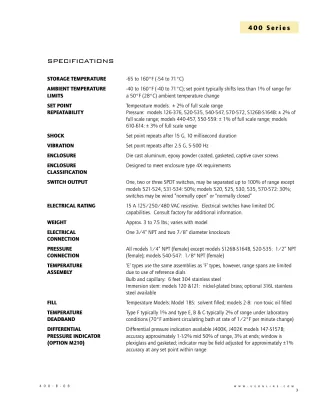
- 15 A 125/250/480 VAC resistive; limited DC capability p. 3
- Set point repeatability
- Model 126: ± 2% of full scale range p. 3
- Ambient temperature
- -40 to 160°F (-40 to 71°C); set point shifts typically under 1% of range per 50°F change p. 3
- Enclosure
- Die cast aluminum, epoxy powder coated, gasketed; designed to meet type 4X p. 3
- Electrical connection
- One 3/4" NPT and two 7/8" diameter knockouts p. 3
- Switch wiring
- SPDT switches may be wired normally open or normally closed p. 3
- Shock and vibration
- Set point repeats after 15 G, 10 ms shock and 2.5 G, 5-500 Hz vibration p. 3
- Storage temperature
- -65 to 160°F (-54 to 71°C) p. 3
- Weight
- Approx. 3 to 7.5 lbs., varies with model p. 3
- Approvals
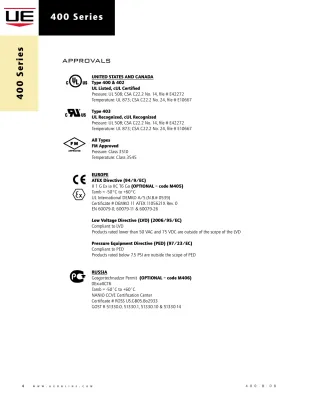
- The manual states types 400 and 402 are UL listed and cUL certified (pressure: UL 508; CSA C22.2 No. 14) and all types FM approved p. 4
- Mounting kit
- Surface and pipe mounting kit part number 6361-704 p. 12
- Series ranges
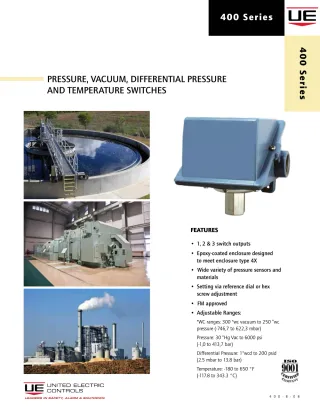
- Pressure 30 "Hg vac to 6000 psi; differential 1"wcd to 200 psid; temperature -180 to 650 °F p. 1
What this sheet walks you through
- Building a part number from type, model and option p. 11
- Choosing a pressure model by set point range, deadband and proof pressure p. 5, 6, 7, 8, 11
- Switch options and other ordering options p. 12
- Approvals and certifications for the US, Canada, Europe and Russia p. 4
- Overall dimensions by model p. 14
Good to know
- Models 126 and 134 have a zinc-plated steel spring exposed to the process media. p. 7
- All switches have limited DC capabilities; the catalog says to consult the factory. p. 12
- To meet NEMA 4X when wiring through the knockout holes, a watertight conduit fitting is required. p. 12
- Proof pressure causes no permanent damage, but the unit may then require calibration. p. 7
Questions this sheet answers
What does H400 mean in a United Electric 400 Series part number?
Type H400 is a pressure switch with one SPDT output and internal adjustment with a reference dial. p. 11
What pressure connection does the UE 400 Series model 126 have?
A nickel-plated brass 1/4" NPT (female) connection on a brass bellows sensor. p. 7
What is the switch rating of the United Electric 400 Series?
15 A 125/250/480 VAC resistive; the switches have limited DC capability. p. 3
How repeatable is the set point of a model 126 pressure switch?
Models 126-376 repeat within ± 2% of full scale range. p. 3
How do I build a United Electric 400 Series part number?
Choose a type, then a model from the model charts, then any option, and fill in each portion of the part number. p. 11
The whole text · 2 parts
Read the sheet here as text
Its text as extracted from the PDF, unedited, in parts; each page opens the PDF at that page.
The file