Spec sheet · Wedgewood
Wedgewood Model 702 Spec Sheet
Spec sheet3 pagesPDF 101 KB
All 3 pages are below, each with its text.
Covers · 1 model
The models it covers
From the sheet · read page by page
Key facts from this sheet
Each line names its page in the PDF.
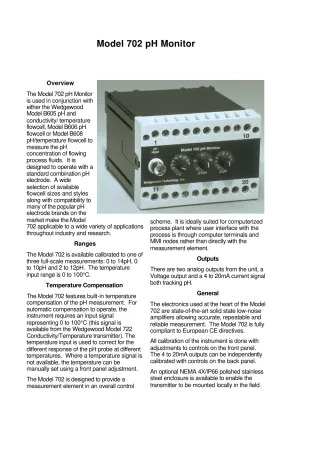
A specification sheet for the Wedgewood Model 702 pH Monitor, which measures the pH of flowing process fluids with a standard combination pH electrode in a Wedgewood flowcell. It describes the ranges, temperature compensation, outputs, power and size, and how to build a part number.
- Type
- pH monitor for flowing process fluids, used with Model B605, B606 or B608 flowcells p. 1
- Electrode
- Standard combination pH electrode p. 1
- pH ranges
- Calibrated to one of 0 to 14pH, 0 to 10pH or 2 to 12pH p. 1
- Temperature input
- 0 to 100°C, as a 0 to 2Vdc signal p. 1, 2
- Outputs
- 4 to 20mA (0-400 ohm load) and 0 to 2Vdc (10K ohm load min), both tracking pH p. 1, 2
- Power
- 115/230 Vac +/- 15%, 50/60 Hz, 6VA; optional 20-28Vdc, 5W p. 2
- Operating environment
- 0 to 55 C; 0 to 90% RH p. 2
- Size and mounting
- 35mm DIN rail mount, 74 x 119 x 100mm (2.91" x 4.69" x 3.94") p. 2
- Temperature compensation
- Automatic from a 0 to 100°C input signal, or set by hand on the front panel p. 1
- Calibration
- Front panel controls; 4 to 20mA outputs calibrated separately on the back panel p. 1
- Range codes
- C: 0-10 pH; D: 2-12 pH; E: 0-14 pH p. 2
- Field enclosure
- Optional polished stainless steel enclosure; the sheet states NEMA 4X/IP66 p. 1
- CE
- The sheet states it is fully compliant to European CE directives p. 1
What this sheet walks you through
- Using automatic or manual temperature compensation p. 1
- Calibrating from the front panel and the current outputs from the back panel p. 1
- Building a part number by range, power supply and cable p. 2
Good to know
- Automatic temperature compensation needs a 0 to 100°C input signal, such as from the Model 722 transmitter. p. 1
Questions this sheet answers
What pH ranges does the Wedgewood Model 702 cover?
It is calibrated to one of three full scale ranges: 0 to 14 pH, 0 to 10 pH or 2 to 12 pH. p. 1
How does the Model 702 compensate for temperature?
Automatically from a 0 to 100°C input signal, such as from a Model 722; without one, the temperature is set on the front panel. p. 1
What outputs does the Wedgewood 702 pH monitor have?
A 4 to 20 mA current output and a 0 to 2 Vdc voltage output, both tracking pH. p. 1, 2
What power does the Model 702 need?
115/230 Vac +/- 15%, 50/60 Hz, 6 VA, or an optional 20-28 Vdc, 5 W supply. p. 2
The file
Size and text
Every page · 3
Read it here
Each page as it is printed, and its words beside it, so a phone can search and copy them.
Page1of 3
Open in the PDF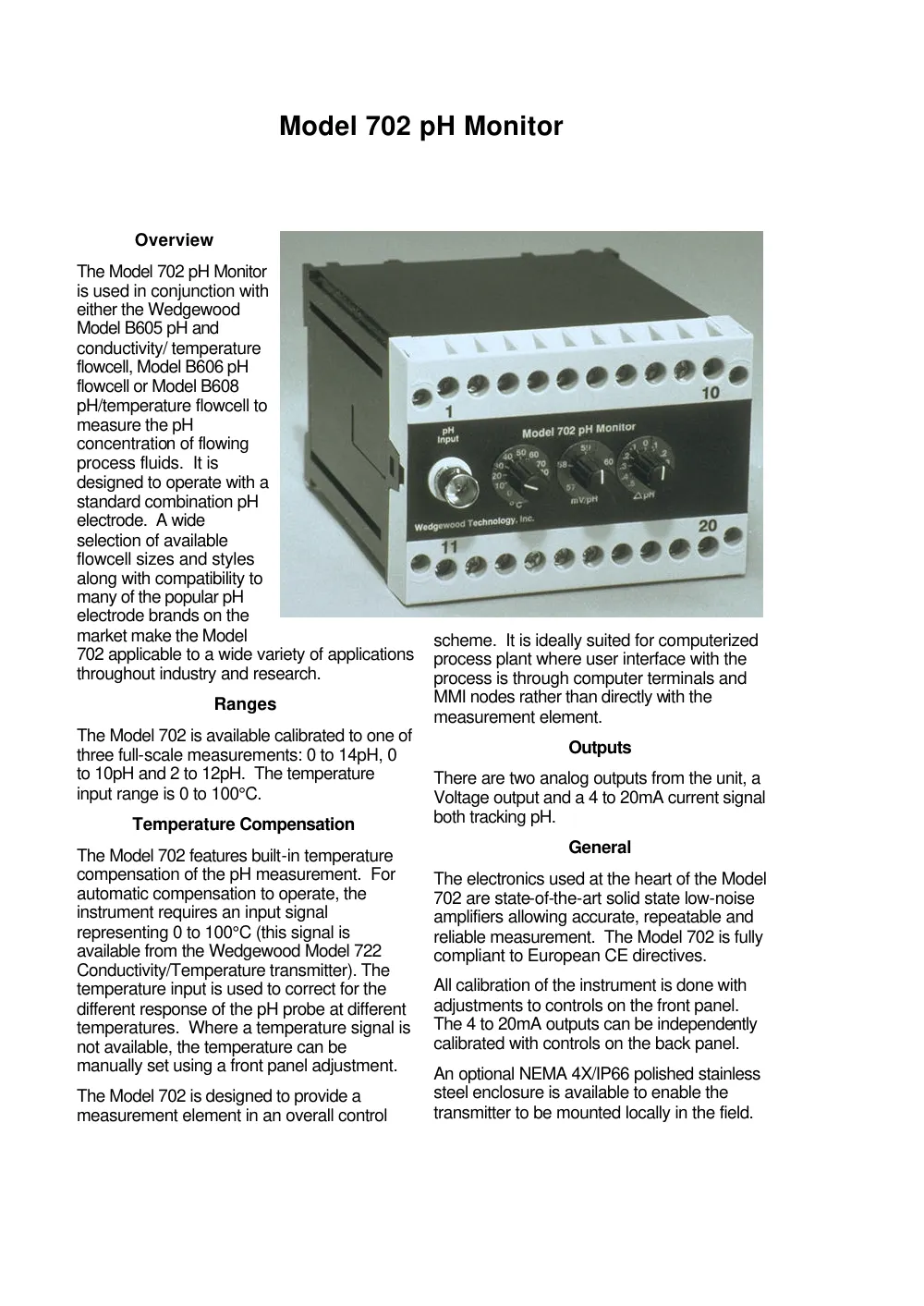
The text of page 1, from the PDF itself
Model 702 pH Monitor
Overview The Model 702 pH Monitor is used in conjunction with either the Wedgewood Model B605 pH and conductivity/ temperature flowcell, Model B606 pH flowcell or Model B608 pH/temperature flowcell to measure the pH concentration of flowing process fluids. It is designed to operate with a standard combination pH electrode. A wide selection of available flowcell sizes and styles along with compatibility to many of the popular pH electrode brands on the market make the Model 702 applicable to a wide variety of applications throughout industry and research. Ranges The Model 702 is available calibrated to one of three full-scale measurements: 0 to 14pH, 0 to 10pH and 2 to 12pH. The temperature input range is 0 to 100°C. Temperature Compensation The Model 702 features built-in temperature compensation of the pH measurement. For automatic compensation to operate, the instrument requires an input signal representing 0 to 100°C (this signal is available from the Wedgewood Model 722 Conductivity/Temperature transmitter). The temperature input is used to correct for the different response of the pH probe at different temperatures. Where a temperature signal is not available, the temperature can be manually set using a front panel adjustment. The Model 702 is designed to provide a measurement element in an overall control
scheme. It is ideally suited for computerized process plant where user interface with the process is through computer terminals and MMI nodes rather than directly with the measurement element. Outputs There are two analog outputs from the unit, a Voltage output and a 4 to 20mA current signal both tracking pH. General The electronics used at the heart of the Model 702 are state-of-the-art solid state low-noise amplifiers allowing accurate, repeatable and reliable measurement. The Model 702 is fully compliant to European CE directives. All calibration of the instrument is done with adjustments to controls on the front panel. The 4 to 20mA outputs can be independently calibrated with controls on the back panel. An optional NEMA 4X/IP66 polished stainless steel enclosure is available to enable the transmitter to be mounted locally in the field.
Page2of 3
Open in the PDF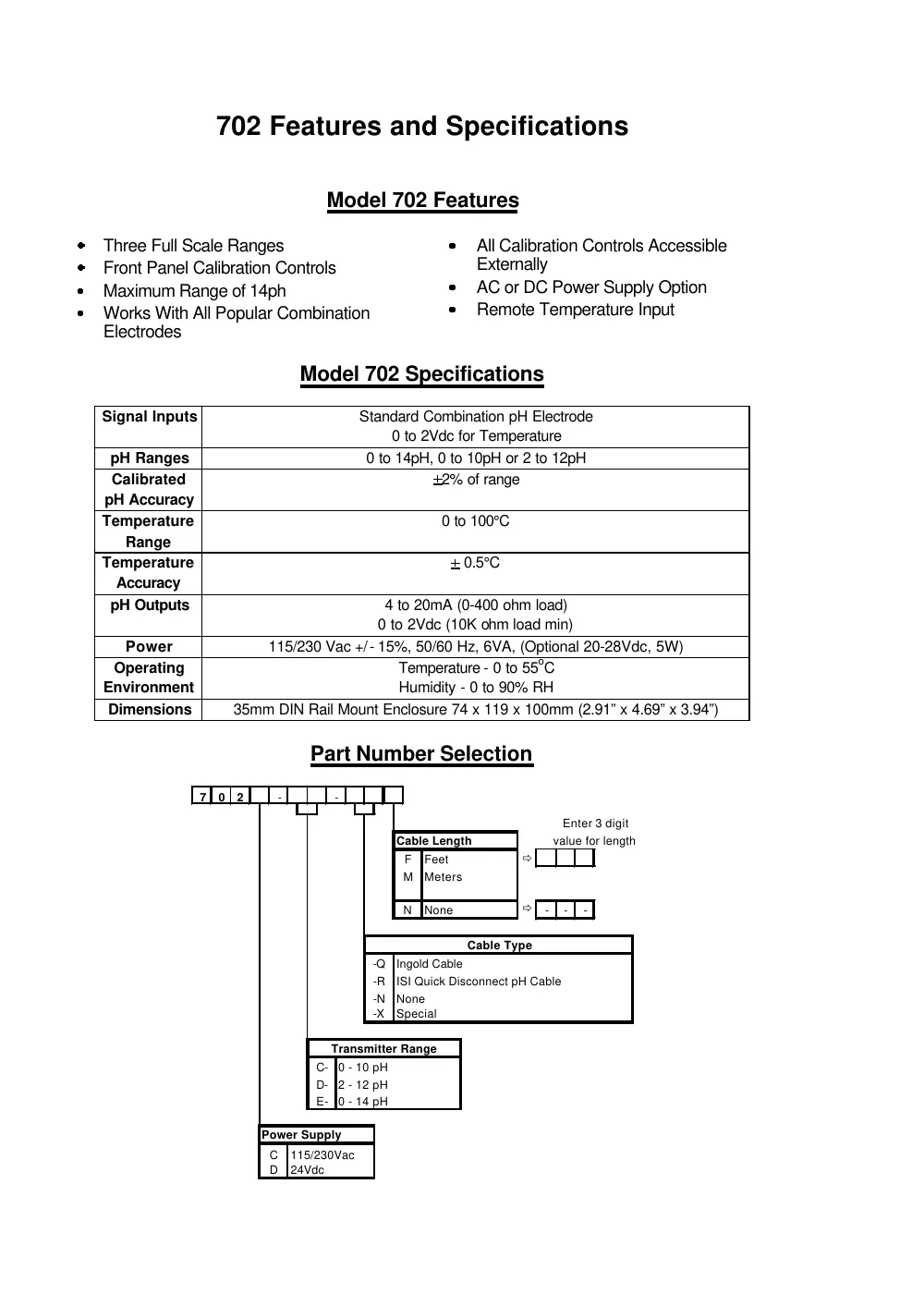
The text of page 2, from the PDF itself
702 Features and Specifications Model 702 Features Three Full Scale Ranges Front Panel Calibration Controls Maximum Range of 14ph Works With All Popular Combination Electrodes
All Calibration Controls Accessible Externally AC or DC Power Supply Option Remote Temperature Input
Model 702 Specifications Signal Inputs
Standard Combination pH Electrode 0 to 2Vdc for Temperature 0 to 14pH, 0 to 10pH or 2 to 12pH 2% of range
pH Ranges Calibrated pH Accuracy Temperature Range Temperature Accuracy pH Outputs
0 to 100°C 0.5°C 4 to 20mA (0-400 ohm load) 0 to 2Vdc (10K ohm load min) 115/230 Vac +/ - 15%, 50/60 Hz, 6VA, (Optional 20-28Vdc, 5W) o Temperature - 0 to 55 C Humidity - 0 to 90% RH 35mm DIN Rail Mount Enclosure 74 x 119 x 100mm (2.91” x 4.69” x 3.94”)
Power Operating Environment Dimensions
Part Number Selection 7
02-
Enter 3 digit value for length
Cable Length F Feet M Meters
ðNðNone-Cable Type -Q -R -N -X
Ingold Cable ISI Quick Disconnect pH Cable None Special
Transmitter Range C- 0 - 10 pH D- 2 - 12 pH E- 0 - 14 pH Power Supply C D
115/230Vac 24Vdc--
Page3of 3
Open in the PDF
The text of page 3, from the PDF itself